
| Sago Palm |

|
 |

|


| File size | 709838 |
| Original date | 5/8/05 11:12 AM |
| Resolution | 2048 x 1536 |
| Flash | Flash did not fire, auto |
| Focal length | 9.3mm |
| Exposure time | 1/324s |
| Aperture | 5.9 |
| Focus Distance | |
| Metering Mode | Partial |
| Camera make | NIKON |
| Camera model | E3700 |
| Sensor type |
 |
 ntroduced ntroduced |
 |
 |
Photo: |
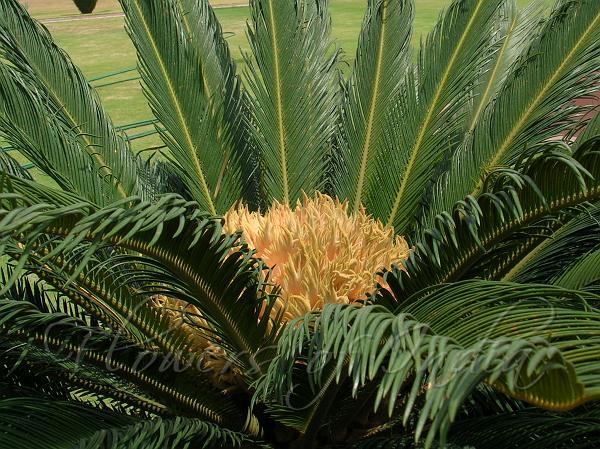
Botanical name: Cycas revoluta Family: Cycadaceae (Sago Palm family)
Sago palms have become very popular landscape plants in modern, classy
Indian gardens. But most people do not realize that these are not palms at
all, despite the name and appearance. Sago palm is actually a cycad. Cycads
are a group of plants that are very primitive in their origins. Fossils have
been found on almost every continent on the planet. It is often stated that
cycads have evolved little since the days of the dinosaurs.
There are species that seemed to show little
evolution over millions of years. Therefore as a group, cycads are often
referred to as “living fossils”. Sago Palms have erect, sturdy trunks that
are typically about one to two feet in diameter, sometimes wider and can grow
into very old specimens with twenty feet of trunk. The leaves are a dark olive
green and about three to four feet long when the plants are of a reproductive
age. Sago palms are very slow growing plants. So, mostly one finds only
young plants which have not grown a stem and look like a rosette of leaves
coming from a stem near the ground. The name revoluta was given
because of the revolute (to curl back) nature of the leaflets; the edges roll
under the leaflet.
| Identification credit: Tabish | Photographed in Millenium Park, New Delhi. |
• Is this flower misidentified? If yes,