
| Skunk Vine |

|
 |

|


 |
 ative ative |
 |
 |
Photo: |
Botanical name: Paederia foetida Family: Rubiaceae (Coffee family)
Synonyms: Paederia scandens, Gentiana scandens, Paederia magnifica, Paederia tomentosa
Synonyms: Paederia scandens, Gentiana scandens, Paederia magnifica, Paederia tomentosa
Skunk Vine is a perennial twining vine arising from a woody rootstock.
Stems grow up to 7 m or more, climbing, or prostrate and rooting at the
nodes. Leaves are oppositely arranged, sometimes in whorls of 3, with
prominent stipules. Leaf stalks are mostly up to 6 cm long. Leaves are
oval to linear-lanceolate, 2-11 cm long, hairy or smooth, often lobed at
base. Leaves and stems have a atinking smell, especially when crushed.
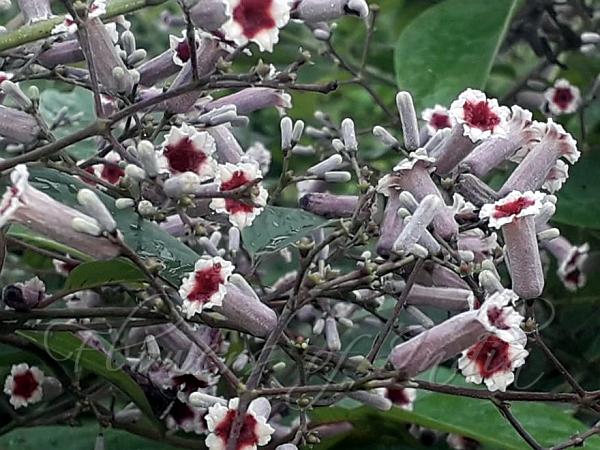
Flowers are small, grayish pink or lilac, in broad or long, curving
clusters at the end of branches or in leaf axils. Flowers are densely
hairy, tubular with 5 spreading petals. Fruit is a shiny brown, nearly
round capsule, up to 0.7 cm across, with 2 black, roundish seeds. Skunk
Vine is found growing on hillsides, in forests, along forest edges, along
streamsides, and twining on trees, in whole of NE India and West Bengal.
Medicinal uses: The plant has numerous medicinal uses in traditional medicine, including
treating joint pain, inflammation, digestive issues like diarrhea and dysentery,
and skin problems. Its traditional applications also extend to ailments like
fever, coughs, and asthma, with various parts of the plant used for both
external and internal treatments.
The plant has numerous medicinal uses in traditional medicine, including
treating joint pain, inflammation, digestive issues like diarrhea and dysentery,
and skin problems. Its traditional applications also extend to ailments like
fever, coughs, and asthma, with various parts of the plant used for both
external and internal treatments.
Medicinal uses:
The plant has numerous medicinal uses in traditional medicine, including
treating joint pain, inflammation, digestive issues like diarrhea and dysentery,
and skin problems. Its traditional applications also extend to ailments like
fever, coughs, and asthma, with various parts of the plant used for both
external and internal treatments.
| Identification credit: K. Haridasan | Photographed in Dibang Valley & East-Siang, Arunachal Pradesh. |
• Is this flower misidentified? If yes,