
| South Indian Black Plum |

|
 |

|


| File size | 734509 |
| Original date | 4/9/23 10:35 AM |
| Resolution | x |
| Flash | Flash did not fire, auto |
| Focal length | 250.0mm |
| Exposure time | 1/1250s |
| Aperture | 8.0 |
| Focus Distance | |
| Metering Mode | Multi-segment |
| Camera make | Canon |
| Camera model | Canon EOS 700D |
| Sensor type |
 |
 ative ative |
 |
 |
 |
Photo: |
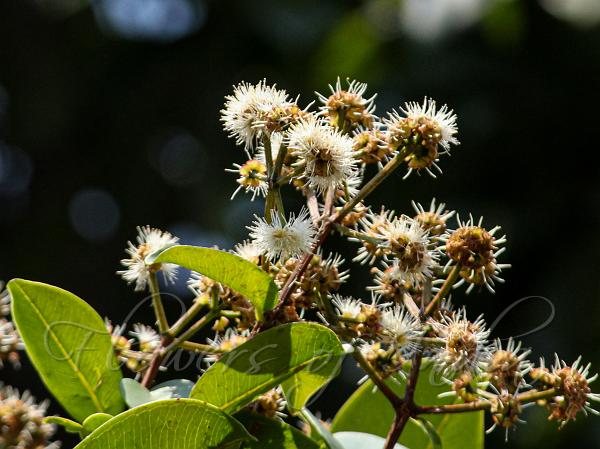
Botanical name: Syzygium rubicundum Family: Myrtaceae (Bottlebrush family)
Synonyms: Eugenia rubicunda, Eugenia lissophylla, Syzygium lissophyllum
Synonyms: Eugenia rubicunda, Eugenia lissophylla, Syzygium lissophyllum
South Indian Black Plum is a tree, up to 15 m tall,
bark pale brown, thin, smooth; branchlets 4-amgled. Leaves are simple,
opposite; leaf-stalk 5-6 mm long, slender, grooved above, hairless;
blade 2.5-10 x 1.5-5.5 cm, ovate-lanceshaped, elliptic-obovate or
ovate, base narrowed or wedge-shaped, tip with a tail tapering or
bluntly tapering, margin entire, hairless, leathery; lateral nerves
many, parallel, close, very slender, faint, looped at the margin
forming obscure intramarginal nerve, intercostae netveined, obscure.
Flowers are bisexual, small, pinkish-white, in leaf-axils and at
branch-ends, in densely flowered, corymb-like cymes; shortly stalked.
Sepal-tube is 2 x 2.5 mm long, top-shaped, sepals 4; no thickened disc,
petals 3 mm across, calyptrate; stamens many, free, bent inwards at the
middle in bud; filaments 4 mm long, spreading, style 1. Fruit is a
spherical, purplish-black berry, 6 mm across. South Indian Black Plum
is found in Western Ghats and Sri Lanka.
| Identification credit: Prasad Balkrishna Gavade | Photographed in Chaukul, Tal-Sawantwadi, Maharashtra. |
• Is this flower misidentified? If yes,