
| Sow Thistle |

|
 |

|


| File size | 679150 |
| Original date | 3/12/06 3:33 PM |
| Resolution | 2048 x 1536 |
| Flash | Flash did not fire, auto |
| Focal length | 8.0mm |
| Exposure time | 1/150s |
| Aperture | 3.2 |
| Focus Distance | |
| Metering Mode | Partial |
| Camera make | NIKON |
| Camera model | E3700 |
| Sensor type |
 |
 aturalized aturalized |
 |
Photo: |
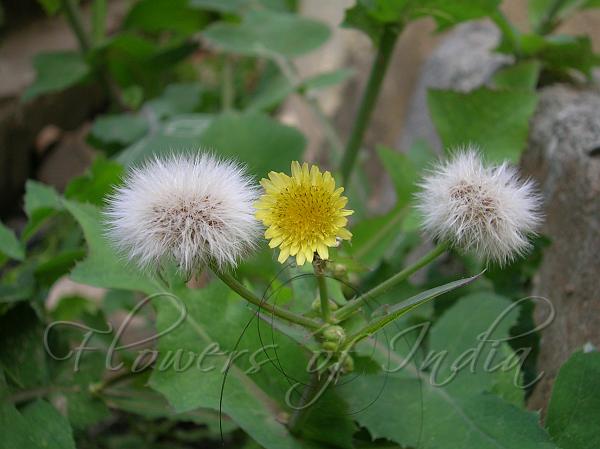
Botanical name: Sonchus oleraceus Family: Asteraceae (Sunflower family)
Sow Thistle is an erect annual herb, with basal leaves, branching above.
Stems are hollow, mostly hairless, ooze milky sap when broken. Leaves are
green, light or dark green, alternate. Basal leaves abd upper leaves are
variable in plant, oblong, obovate, lanceshaped, often winged at base,
spiny edges deeply lobed. Flowers are yellow, small, about 1.2-2.5 cm,
on tips of flowering stalks. The flower-heads consist of strap-shaped florets.
Flowers-heads are borne in open clusters. Fruit is an achene with white
hairs on one end, seeds are wind dispersed. Sow Thistle is native to
Europe to Mediterranean, Sahara to Arabian Peninsula. It is naturalized
widely the world over, including India. It can be found in the Himalaya,
at altitudes of 170-3200 m. Flowering: March-December.
Medicinal uses: Plant is useful in liver diseases. Leaves and roots
are used in indegestion as febrifuge; stem is used as sedative, tonic; root
extract is used in ointments for ulcers and wounds. Gum produced by
evaporating latex is used for ascites and hydrothorax.
Plant is useful in liver diseases. Leaves and roots
are used in indegestion as febrifuge; stem is used as sedative, tonic; root
extract is used in ointments for ulcers and wounds. Gum produced by
evaporating latex is used for ascites and hydrothorax.
Medicinal uses:
Plant is useful in liver diseases. Leaves and roots
are used in indegestion as febrifuge; stem is used as sedative, tonic; root
extract is used in ointments for ulcers and wounds. Gum produced by
evaporating latex is used for ascites and hydrothorax.| Identification credit: Tabish | Photographed in Delhi & Imphal, Manipur. |
• Is this flower misidentified? If yes,