
| Tobacco |

|
 |

|


| File size | 619624 |
| Original date | 6/3/19 5:47 PM |
| Resolution | 2048 x 1536 |
| Flash | Flash did not fire, auto |
| Focal length | 19.2mm |
| Exposure time | 1/100s |
| Aperture | 3.6 |
| Focus Distance | |
| Metering Mode | Spot |
| Camera make | Panasonic |
| Camera model | DMC-FZ18 |
| Sensor type | OneChipColorArea |
 |
 ntroduced ntroduced |
 |
 |
 |
Photo: |
Botanical name: Nicotiana tabacum Family: Solanaceae (Potato family)
Synonyms: Nicotiana tabaca, Nicotiana mexicana, Nicotiana chinensis
Synonyms: Nicotiana tabaca, Nicotiana mexicana, Nicotiana chinensis
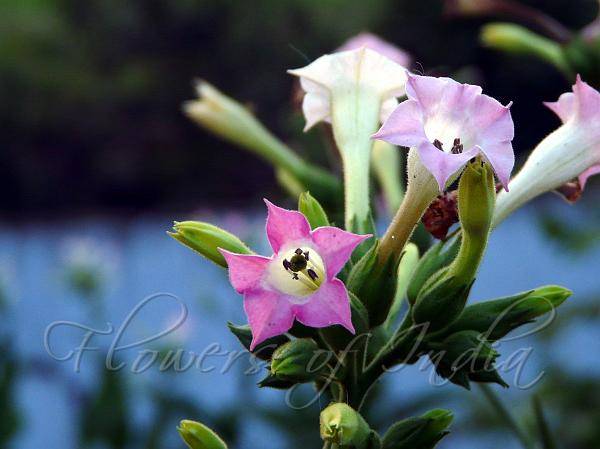
Tobacco is a is a robust annual little branched herb
up to 2.5 m tall with large green leaves and long trumpet-shaped
white-pinkish flowers. All parts are sticky, covered with short
sticky-glandular hairs, which exude a yellow secretion containing
nicotine. Flowers are borne in branch-end many-flowered clusters.
Flower tube is 5-6 cm long, 5 mm in diameter, expanded in the lower
third and upper third, petals broadly triangular, white-pinkish with
pale violet or carmine colored tips tube yellowish white. Calyx is with
five narrowly triangular sepals which are 1.5-2 cm long. Leves are
varied in size, the lower leaves are the largest at up to 60 cm long,
short-stalked or unstalked, oblonged-elliptic, shortly tapering at the
tip, decurrent at the base, the upper one stalkless and smallest,
oblong-lanceshaped or elliptic. Fruit is capsular ovoid or ellipsoid,
surrounded by the persistent calyx and with a short apical beak, about
2 cm long. Seeds are very numerous, very small, ovoid or kidney shaped,
brown. Tobacco is a native of tropical and subtropical America but it
is now commercially cultivated worldwide.
| Identification credit: Navendu Pāgé | Photographed in cultivation in Arunachal Pradesh. |
• Is this flower misidentified? If yes,