
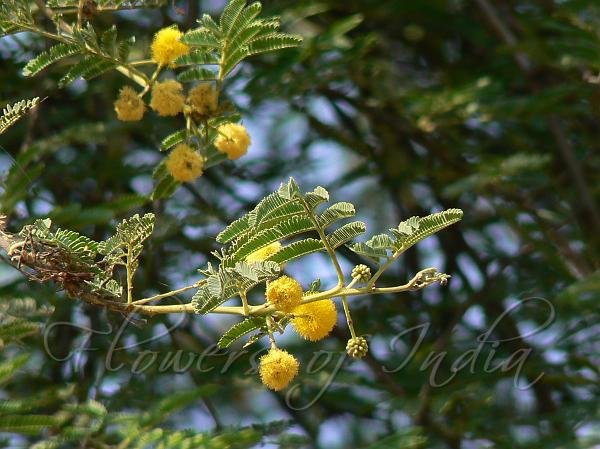
| Tomentose Babool |

|
 |

|


| File size | 1434817 |
| Original date | 12/25/07 2:34 PM |
| Resolution | 2048 x 1536 |
| Flash | Flash did not fire, auto |
| Focal length | 72.0mm |
| Exposure time | 1/250s |
| Aperture | 5.6 |
| Focus Distance | |
| Metering Mode | Multi-segment |
| Camera make | Panasonic |
| Camera model | DMC-FZ7 |
| Sensor type | OneChipColorArea |
 |
 ative ative |
 |
 |
Photo: |
Botanical name: Vachellia nilotica subsp. tomentosa Family: Mimosaceae (Touch-me-not family)
Synonyms: Acacia arabica, Acacia arabica var. tomentosa
Synonyms: Acacia arabica, Acacia arabica var. tomentosa
Tomentose Babool is a very abundant subspecies in India and Pakistan, is
also widespread in part of Africa. It is most often found on alluvial
soils that are periodically flooded, sandy-clays and non-saline clay
soils. It is resistant to temporary flooding and can grow in waterlogged
soils for long periods. Unlike Babool, Tomentose
Babool may be thorny when the tree is young, but at maturity the tree has
few spines. The characteristic of the tree is densely tomentose, white
pods which are deeply constricted between the seeds to make it look like a
beaded necklace. Flowers are tiny yellow powder-puffs, occuring in
clusters. The leaves are twice compound, i.e. they consist of 5-11
feather-like pairs of pinnae; each pinna is further divided into 7-25
pairs of small, elliptic leaflets.
| Identification credit: Dinesh Valke | Photographed at Vaghbil, Thane, Maharashtra. |
• Is this flower misidentified? If yes,