
| True Indigo |

|
 |

|


 |
 aturalized aturalized |
 |
 |
 |
Photo: |
Botanical name: Indigofera tinctoria Family: Fabaceae (Pea family)
Synonyms: Indigofera indica Lam., Indigofera sumatrana
Synonyms: Indigofera indica Lam., Indigofera sumatrana
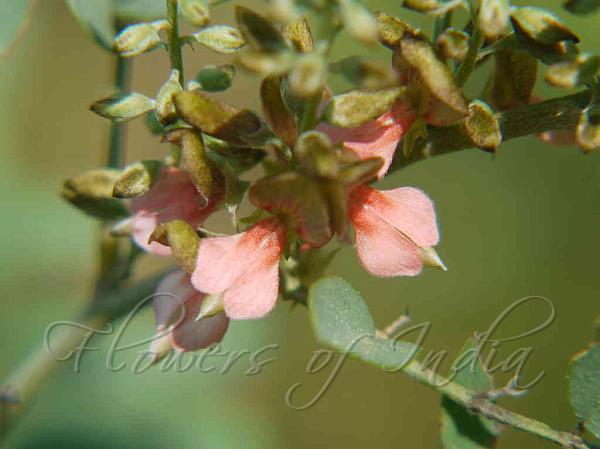
True Indigo is an erect shrub, 50-100 cm tall. Leaves
are compound, 2.5-11 cm long, with 9-13 leaflets. Leaf-stalk 1.3-2.5
cm; stipels minute; leaflet-stalks about 2 mm; leaflet blades
opposite, obovate-oblong to obovate, 1.5-3 x 0.5-1.5 cm, both surfaces
with appressed medifixed trichomes, above sometimes hairless, base
broadly wedge-shaped to rounded, tip rounded to notched. Flowers are
borne in racemes 2.5-5 cm, laxly flowered; flower-cluster-stalk
absent; bracts bristlelike, 1-1.5 mm. Flower-stalks are 4-5 mm,
reflexed in fruit. Calyx is about 1.5 mm, with trichomes; teeth
triangular, as long as tube. Flowers are red; standard broadly
obovate, 4-5 mm, outside with brown trichomes; wings about 4 mm; keel
as long as wings. Stamens 4-5 mm; anthers heart-shaped. Ovary hairless.
Pods are linear, deflexed and straight to semicircular but never sickle
shaped, 2.5-3 cm, hairy or hairless; endocarp purplish red blotched.
Seeds are 5-12 per legume, cubic, about 1.5 mm. True Indigo's origin is
uncertain, but it is widely cultivated in tropical and subtropical
Asia. Flowering: all year.
Medicinal uses: True Indigo used for Glowing
Skin, Sores, Ringworm, Blisters, Hair rejuvenation, natural hair
darkening, removing Worms in Teeth and Gums, Sores on Skin, Liver,
Urinary problems and poison, Mouth ulcers or Canker sores, Kidney
disease, Insects in Ear, Black Hair and Hair fall, Dog bite.
True Indigo used for Glowing
Skin, Sores, Ringworm, Blisters, Hair rejuvenation, natural hair
darkening, removing Worms in Teeth and Gums, Sores on Skin, Liver,
Urinary problems and poison, Mouth ulcers or Canker sores, Kidney
disease, Insects in Ear, Black Hair and Hair fall, Dog bite.
Medicinal uses:
True Indigo used for Glowing
Skin, Sores, Ringworm, Blisters, Hair rejuvenation, natural hair
darkening, removing Worms in Teeth and Gums, Sores on Skin, Liver,
Urinary problems and poison, Mouth ulcers or Canker sores, Kidney
disease, Insects in Ear, Black Hair and Hair fall, Dog bite. | Identification credit: J.M. Garg | Photographed in Vaghbil, Thane, Maharashtra. |
• Is this flower misidentified? If yes,