
| Tulsi |

|
 |

|


| File size | 431668 |
| Original date | 7/24/09 10:45 PM |
| Resolution | 2048 x 1536 |
| Flash | Flash did not fire, auto |
| Focal length | 45.0mm |
| Exposure time | 1/100s |
| Aperture | 5.6 |
| Focus Distance | |
| Metering Mode | Multi-segment |
| Camera make | SONY |
| Camera model | DSLR-A100 |
| Sensor type |
 |
 ative ative |
 |
 |
Photo: |
Botanical name: Ocimum tenuiflorum Family: Lamiaceae (Mint family)
Synonyms: Ocimum sanctum
Synonyms: Ocimum sanctum
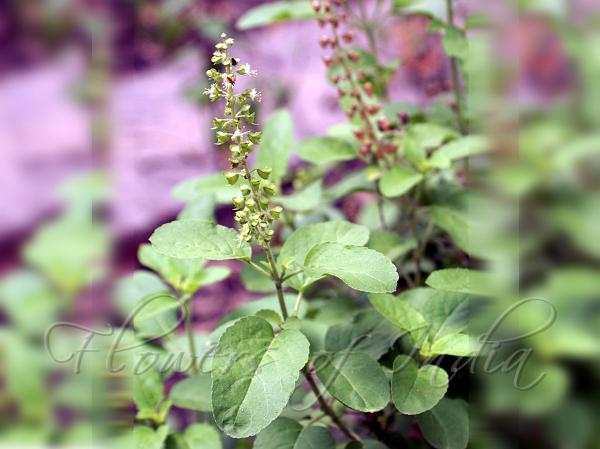
Tulsi (Ocimum sanctum) is a widely grown, sacred plant of India. Hindus grow
Tulsi as a religious plant in their homes, temples and their farms. They use
Tulsi leaves in routine worship. Tulsi, grown as a pot plant, is found in
almost every traditional Hindu house. The natural habitat of Tulsi
varies from sea level to an altitude of 2000 m. It is found growing naturally
in moist soil nearly all over the globe.
Tulsi is a branched, fragrant and erect herb having hair all over. It
attains a height of about 75 to 90 cm when mature. Its leaves are nearly
round and up to 5 cm long with the margin being entire or toothed. These are
aromatic because of the presence of a kind of scented oil in them. A variety
with green leaves is called Shri Tulsi and one with reddish leaves is called
Krishna Tulsi. Tulsi flowers are small having purple to reddish color,
present in small compact clusters on cylindrical spikes. Stalkless
heart-shaped bracts are there at the base of each flower cluster. Sepal
cup is not hairy within. Flowers are rarerly longer than 5 mm, calyx tube
bearded outside near base. Flower tube is hairy. The fruits are small and
the seeds yellow to reddish in color.
Medicinal uses: Because of its medicinal virtues, Tulsi is
used in Ayurvedic preparations for treating various ailments.
Because of its medicinal virtues, Tulsi is
used in Ayurvedic preparations for treating various ailments.
Medicinal uses:
Because of its medicinal virtues, Tulsi is
used in Ayurvedic preparations for treating various ailments.| Identification credit: Gurcharan Singh | Photographed in Delhi |
• Is this flower misidentified? If yes,