
| Velvet Bean |

|
 |

|


| File size | 687309 |
| Original date | 10/16/21 2:12 PM |
| Resolution | 3648 x 2736 |
| Flash | Flash did not fire, auto |
| Focal length | 4.3mm |
| Exposure time | 1/100s |
| Aperture | 3.4 |
| Focus Distance | |
| Metering Mode | Center weighted average |
| Camera make | NIKON |
| Camera model | COOLPIX A900 |
| Sensor type |
 |
 ative ative |
 |
 |
Photo: |
Botanical name: Mucuna pruriens Family: Fabaceae (bean family)
Velvet bean is an annual, climbing shrub with long vines that can reach over
15 m. Leaves are trifoliate, gray-silky beneath; petioles are long and silky,
6-11 cm. Leaflets are membranous, terminal leaflets are smaller, lateral
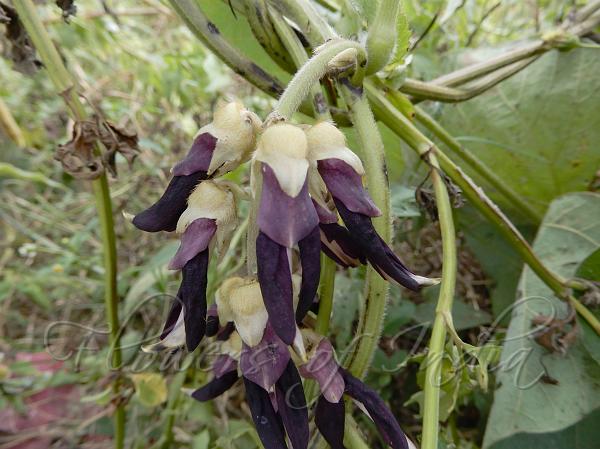
very unequal sided. Dark purple flowers (6 to 30) occur in drooping racemes.
Fruits are curved, 4-6 seeded. The longitudinally ribbed pod, is densely
covered with loose orange hairs which cause a severe itch if they come in
contact with skin. The beans are shiny black or brown. It is found in
tropical Africa, India and the Caribbean. In India, it is found in the Himalayas, at altitudes of 150-1200 m, and Western Ghats.
Medicinal uses: Velvet bean can be beneficial, since it is high in
levodopa which helps maintain healthy cholesterol and blood sugar levels. The
seed powder of Mucuna pruriens has long been used in Ayurvedic
medicine for diseases including parkinsonism, and has proven in medical
tests to have equal or superior effectiveness in the treatment of parkinsons
disease over conventional, synthetic levodopa medications. Another benefit
of Mucuna is that it can increase the production of human growth hormone, and
extracts are commonly sold as body-building supplements.
Velvet bean can be beneficial, since it is high in
levodopa which helps maintain healthy cholesterol and blood sugar levels. The
seed powder of Mucuna pruriens has long been used in Ayurvedic
medicine for diseases including parkinsonism, and has proven in medical
tests to have equal or superior effectiveness in the treatment of parkinsons
disease over conventional, synthetic levodopa medications. Another benefit
of Mucuna is that it can increase the production of human growth hormone, and
extracts are commonly sold as body-building supplements.
Medicinal uses:
Velvet bean can be beneficial, since it is high in
levodopa which helps maintain healthy cholesterol and blood sugar levels. The
seed powder of Mucuna pruriens has long been used in Ayurvedic
medicine for diseases including parkinsonism, and has proven in medical
tests to have equal or superior effectiveness in the treatment of parkinsons
disease over conventional, synthetic levodopa medications. Another benefit
of Mucuna is that it can increase the production of human growth hormone, and
extracts are commonly sold as body-building supplements.| Identification credit: Pravin Kawale | Photographed in Manipur & Maharashtra. |
• Is this flower misidentified? If yes,