
| Water Willow |

|
 |

|


| File size | 745126 |
| Original date | 12/26/22 11:59 AM |
| Resolution | 4032 x 3024 |
| Flash | Flash did not fire, auto |
| Focal length | 1.57mm |
| Exposure time | 1/99s |
| Aperture | 1.8 |
| Focus Distance | |
| Metering Mode | Multi-segment |
| Camera make | Apple |
| Camera model | iPhone 13 Pro |
| Sensor type | OneChipColorArea |
 |
 ative ative |
 |
 |
Photo: |
Botanical name: Rostellularia procumbens Family: Acanthaceae (Acanthus family)
Synonyms: Justicia procumbens, Justicia simplex, Justicia hirtella
Synonyms: Justicia procumbens, Justicia simplex, Justicia hirtella
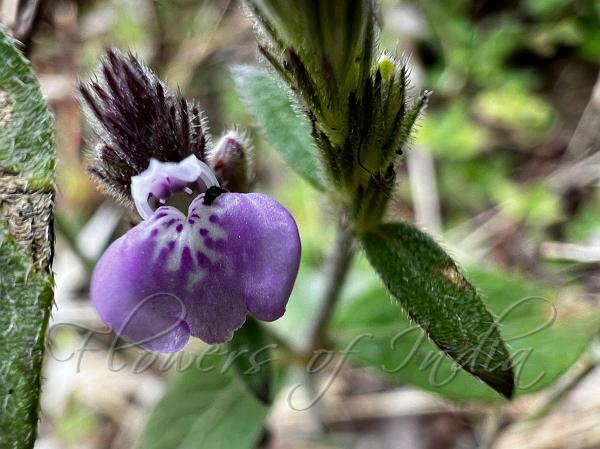
Water Willow is a slender, often tufted, prostrate or ascending, branched
perennial herb. The stems are 10-40 cm long. The leaves are elliptic to
oblong-ovate or ovate, 7-20 mm long, 5-20 mm wide, obtuse at both ends, and
entire or slightly crenate as to margin. The flowers are pink, 6-7 mm long,
and borne in terminal, rather dense, cylindric spikes 1-5 cm long and about 5
mm in diameter. The bracts and sepals are green, linear-lanceolate, and
hairy. The fruit (capsule) is slightly hairy and about 4 mm long.
Water Willow is found throughout India, Himalayas, China and SE Asia
at altitudes up to 1500 m.
Medicinal uses: The herb contains a bitter alkaloid and that it
is used as a substitute for Fumaria. It is alternative and expectorant and
is given in the form of infusion (1 to 20) in asthma, coughs, and
rheumatism. The juice of the leaves is squeezed into the eyes in cases of
ophthalmia. The odor of the whole plant is unpleasant; it is used in
decoction for backache, plethora, and flatulence.
The herb contains a bitter alkaloid and that it
is used as a substitute for Fumaria. It is alternative and expectorant and
is given in the form of infusion (1 to 20) in asthma, coughs, and
rheumatism. The juice of the leaves is squeezed into the eyes in cases of
ophthalmia. The odor of the whole plant is unpleasant; it is used in
decoction for backache, plethora, and flatulence.
Medicinal uses:
The herb contains a bitter alkaloid and that it
is used as a substitute for Fumaria. It is alternative and expectorant and
is given in the form of infusion (1 to 20) in asthma, coughs, and
rheumatism. The juice of the leaves is squeezed into the eyes in cases of
ophthalmia. The odor of the whole plant is unpleasant; it is used in
decoction for backache, plethora, and flatulence. | Identification credit: Hemanth Tripathi | Photographed in Karnataka, Maharashtra & Assam. |
• Is this flower misidentified? If yes,