
| Weeping Forsythia |

|
 |

|


| File size | 677847 |
| Original date | 4/8/09 3:21 PM |
| Resolution | 2048 x 1536 |
| Flash | Flash did not fire, auto |
| Focal length | 8.0mm |
| Exposure time | 1/166s |
| Aperture | 3.2 |
| Focus Distance | |
| Metering Mode | Partial |
| Camera make | NIKON |
| Camera model | E3700 |
| Sensor type |
 |
 ative ative |
 |
 |
Photo: |
Botanical name: Forsythia suspensa Family: Oleaceae (Jasmine family)
Synonyms: Ligustrum suspensum, Syringa suspensa
Synonyms: Ligustrum suspensum, Syringa suspensa
Weeping Forsythia is a deciduous shrub native to China,
and probably bordering north-eastern parts of India. It is cultivated
as a showy but tough flowering plant. Branches are spreading or pendulous
- branchlets are yellow-brown or gray-brown, with hollow internodes.
Leaves are simple, sometimes 3-parted to trifoliate. Leaf stalks are
0.8-1.5 cm. Leaf blade is ovate, broadly ovate, or elliptic-ovate, 2-10 cm
long, 1.5-5 cm wide, somewhat leathery, smooth or sometimes velvety.
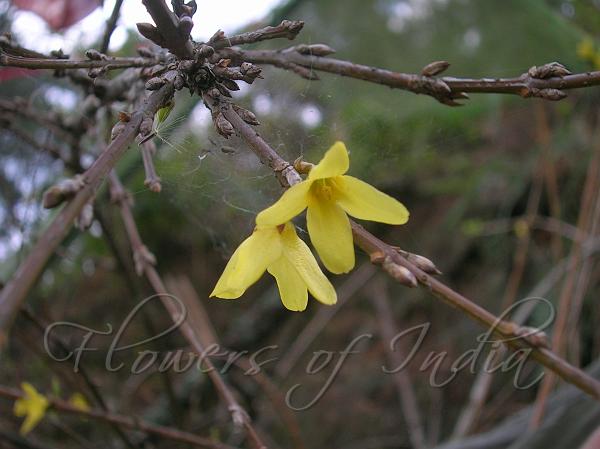
Golden yellow flowers with 4 petals appear solitary or 2 to several in
leaf axils. Flowers-stalks are 5-6 mm long. Sepals are oblong, 6-7 mm. Flower tube is nearly equal to the sepals - petals are obovate-
oblong or oblong, 1.2-2 cm. Pistil is 5-7 mm in flowers with stamens 3-5
mm. Capsule is ovoid to long ellipsoid, 1.2-2.5 cm × 6-12 mm, with
scattered lenticels. Flowering: March-April.
| Identification credit: Tabish | Photographed in Gangtok, Sikkim. |
• Is this flower misidentified? If yes,