
| West Indian Elm |

|
 |

|


| File size | 809816 |
| Original date | 3/31/08 11:38 AM |
| Resolution | 1504 x 1116 |
| Flash | Flash did not fire |
| Focal length | 6.3mm |
| Exposure time | 1/250s |
| Aperture | 4.5 |
| Focus Distance | |
| Metering Mode | Spot |
| Camera make | SONY |
| Camera model | DSC-P52 |
| Sensor type |
 |
 ntroduced ntroduced |
 |
 |
Photo: |
Botanical name: Guazuma ulmifolia Family: Sterculiaceae (Cacao family)
Synonyms: Theobroma guazuma, Guazuma tomentosa
Synonyms: Theobroma guazuma, Guazuma tomentosa
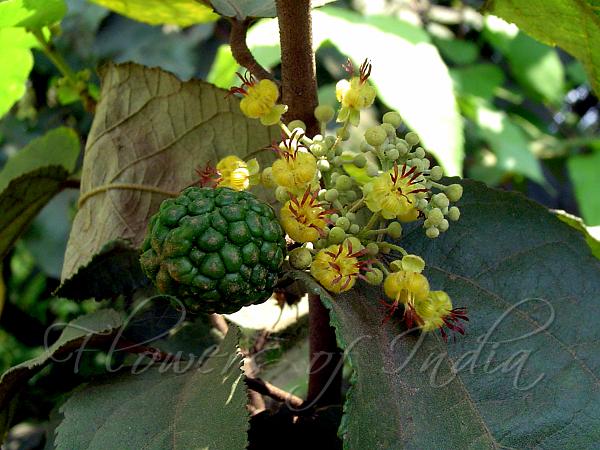
West Indian Elm is a medium-sized tree, usually branched from the base. Leaves are
alternate, in flat plane along long branches, upperside dark green,
underside light green-blue. Leaf base is prominently asymmetric, and leaves
have a rough feel. There are three main leaf veins arising together from
the leaf base, a characteristic of this family as well as several related
families. The tree produces small, whitish-cream flowers during the dry
season. These develop into odd, woody fruits which look similar to the
true Rudraksh, used as beads in rudraaksh maala worn by
sadhus. But the fruits have a cherry flavor if chewed. West Indian Elm
is found in
the Caribbean, Mexico, Central America and Colombia, Ecuador, Peru,
Bolivia, Paraguay, Argentina, and Brazil. It has been cultivated in India
for over 100 years.
| Identification credit: Prashant Awale | Photographed in Chennai. |
• Is this flower misidentified? If yes,