
| White Bark Acacia |

|
 |

|


| File size | 452000 |
| Original date | 9/29/07 9:56 AM |
| Resolution | 2816 x 2112 |
| Flash | Flash did not fire, auto |
| Focal length | 72.0mm |
| Exposure time | 1/400s |
| Aperture | 5.6 |
| Focus Distance | |
| Metering Mode | Multi-segment |
| Camera make | Panasonic |
| Camera model | DMC-FZ7 |
| Sensor type | OneChipColorArea |
 |
 ative ative |
 |
 |
Photo: |
Botanical name: Vachellia leucophloea Family: Mimosaceae (Touch-me-not family)
Synonyms: Mimosa leucophloea, Acacia leucophloea
Synonyms: Mimosa leucophloea, Acacia leucophloea
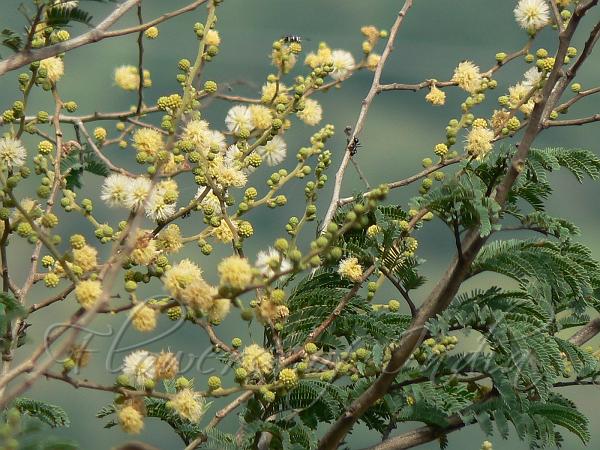
White Bark Acacia is a large thorny tree attaining a height of 35 m and a
diameter at breast height of 100 cm. The stout trunk is divided into
several wide branches. Open-grown specimens have a characteristic wide
umbrella-like crown. Bark is white to yellowish gray, smooth, on old trees
becoming black and rough. Leaves double compound, with 4-13 pairs of
pinnae, each with 5-30 pairs of leaflets. Circular glands found on the
rachis below the junction of paired-pinnae. The feathery green foliage
offers a strong contrast to the light-coloured bark. Spines 2-5 mm long, at
the base of leaves. Flowers conspicuous, light-yellow to cream in colour,
in pendunculate glomerules aggregated in panicles, 5-merous, corolla 1.2-2
mm long, at the end of branches or in leaf axils. Pods yellow, green or
brown in colour, flat and fairly straight, 10-20 cm long, 5-10 mm wide,
containing 10-20 smooth, oblong seeds, dark brown in colour, 6 x 4 mm in
size.
| Identification credit: Dinesh Valke | Photographed at Katraj Ghat, Pune, Maharashtra. |
• Is this flower misidentified? If yes,