
| White Gourd |

|
 |

|


| File size | 682227 |
| Original date | 7/4/05 7:43 AM |
| Resolution | 2048 x 1536 |
| Flash | Flash did not fire, auto |
| Focal length | 5.4mm |
| Exposure time | 1/176s |
| Aperture | 4.8 |
| Focus Distance | |
| Metering Mode | Partial |
| Camera make | NIKON |
| Camera model | E3700 |
| Sensor type |
 |
 ative ative |
 |
 |
Photo: |
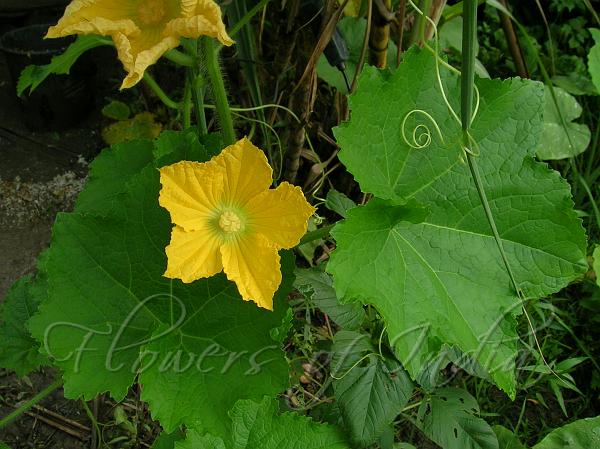
Botanical name: Benincasa hispida Family: Cucurbitaceae (Pumpkin family)
Synonyms: Benincasa cerifera, Cucurbita hispida, Benincasa pruriens
Synonyms: Benincasa cerifera, Cucurbita hispida, Benincasa pruriens
White gourd is a vine grown for its very large fruit, eaten as a
vegetable. The fruit is fuzzy when young. By maturity, the fruit loses its
hairs and develops a waxy coating, giving rise to the name wax gourd, and
providing a long shelf life. Stem is much branched. Leaf stalks are long
and hairy. Leaves roundish, kidney-shaped, base deeply heart-shaped. Upper
surface is rough, lower surface shortly bristly, blade 10-25 cm long and
as much broad, 5-7-lobed, lobes ovate-triangular, margin sinuate or
toothed. Tendrils are slender, rarely simple. Male flower 5-15 cm long,
female 2-4 cm long. Calyx tube 10-15 mm long, densely hairy, lobes
lanceolate, acute, 6-12 mm long. Petals spreading, blunt, but ending in a
short point, 3-5 x 2-4 cm. Filaments of the stamens are inflated and hairy
at the base, anthers trilobed. In north India, the fruit is used in making
the popular sweet पेठा petha.
| Identification credit: Lakshmanan Iyer | Photographed in Imphal, Manipur & Bijor, UP. |
• Is this flower misidentified? If yes,