
| White Leaved Cudweed |

|
 |

|


| File size | 1927645 |
| Original date | 5/19/07 10:12 AM |
| Resolution | 2592 x 1944 |
| Flash | Flash did not fire, auto |
| Focal length | 5.8mm |
| Exposure time | 1/640s |
| Aperture | 2.8 |
| Focus Distance | |
| Metering Mode | Multi-segment |
| Camera make | SONY |
| Camera model | DSC-S650 |
| Sensor type |
 |
 ative ative |
 |
 |
Photo: |
Botanical name: Pseudognaphalium hypoleucum Family: Asteraceae (Sunflower family)
Synonyms: Gnaphalium hypoleucum, Gnaphalium confertum
Synonyms: Gnaphalium hypoleucum, Gnaphalium confertum
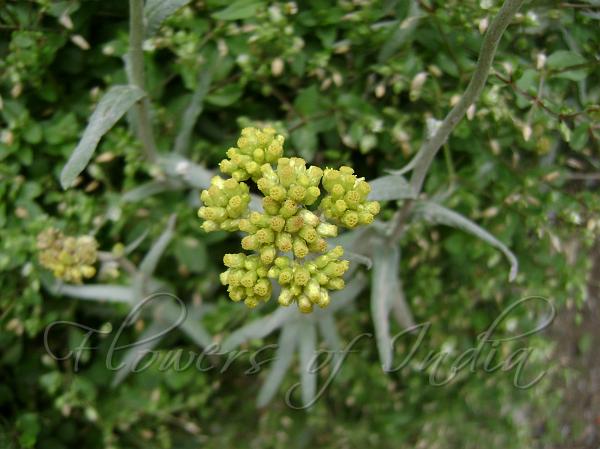
White Leaved Cudweed is a plant of temperate region,
distributed in Eastern and Western Himalayas, ascending up to 3000 m,
growing in forests, roadside and open ground. It is an erect herbs 1-2 ft
tall, usually simple, branched above, greyish velvety to woolly or
brownish glandular. Leaves are linear with entire to crispate or curled
margins, 1.5-7.5 cm long, 0.1-0.7 cm wide, bicoloured, dull green
glandular pubescent on the upper surface, white tomentose beneath. The
species name hypoleucum means white on the underside. Leaves
are stem-clasping. Flower-heads are borne in dense corymbose clusters,
densely woolly, 3-3.5 mm in diameter. Phyllaries are yellow to snow white,
4-5-seriate, 4 mm long, oblong, acute rarely subacute. Outer florets are
threadlike, 2 mm long 3-4 toothed, yellow. Disc florets are 2 mm long,
corolla 5-lobed. Flowering: April-October.
| Identification credit: Gurcharan Singh, Tabish | Photographed in Ukhrul, Manipur & Dhanaulti, Uttarakhand. |
• Is this flower misidentified? If yes,