
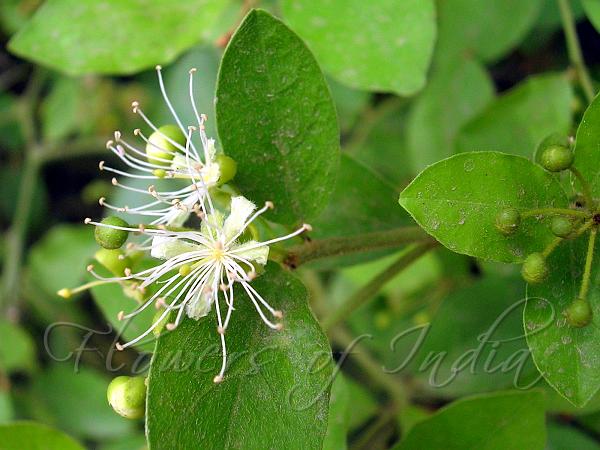
| Wild Caper Bush |

|
 |

|


| File size | 570124 |
| Original date | 5/2/07 2:57 PM |
| Resolution | 1600 x 1200 |
| Flash | Flash did not fire, auto |
| Focal length | 8.0mm |
| Exposure time | 1/253s |
| Aperture | 3.2 |
| Focus Distance | |
| Metering Mode | Partial |
| Camera make | NIKON |
| Camera model | E3700 |
| Sensor type |
 |
 ative ative |
 |
 |
 |
Photo: |
Botanical name: Capparis sepiaria Family: Capparaceae (caper family)
Wild Caper Bush is a spreading or climbing, much branched shrub, 3-4
m long, more or less velvet-hairy with ashy grey simple hairs. Leaves
elliptic oblong to ovate or nearly round, 1.5-4 cm long, 1-2 cm broad,
often retuse, softly velvet-hairy to hairless; leaf-stalk 2-5 mm long,
velvet-hairy; stipular spines 2-5 mm, hooked, often brown-black. Flowers
usually in corymbose at branch-ends clusters of 10-30, small, 5-10
mm across, white; flower-stalks 1-2 cm long, not thickened in fruit,
velvet-hairy. Sepals 3-6 mm long, 2.5-3.5 mm broad, subequal. Petals
oblong-spoon-shaped, 3.5-8 mm long, 2-3 mm broad, more or less hairy at
the base. Stamens many, 5-10 mm long. Gynophore 6-10 mm long, slightly
thickened in fruit. Fruit spherical, 8-12 mm in diam., crustaceous,
dark-brown, smooth, 1-2 seeded; seed about 6 mm. Wild Caper Bush is found
in India, Ceylon, E. Pakistan, Malesia, Indochina, China, Australia and
tropical Africa.
| Identification credit: Navendu Pagé | Photographed in Garden of Five Senses, Delhi. |
• Is this flower misidentified? If yes,