
| Wild Turmeric |

|
 |

|


| File size | 550940 |
| Original date | 3/28/07 5:55 PM |
| Resolution | 1024 x 768 |
| Flash | Flash fired |
| Focal length | |
| Exposure time | 1/125s |
| Aperture | 2.4 |
| Focus Distance | |
| Metering Mode | $meteringMode |
| Camera make | Panasonic |
| Camera model | NV-GS400 |
| Sensor type |
 |
 ative ative |
 |
 |
Photo: |
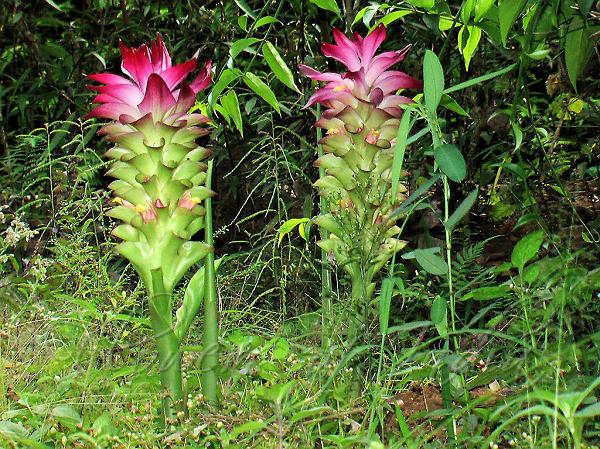
Botanical name: Curcuma aromatica Family: Zingiberaceae (Ginger family)
Wild tumeric is an aromatic
and pretty ginger with stout underground rhizomes. Foliage dies down in late in
autumn and the rhizomes remain dormant in winter. The inflorescence appears in
early spring from the base of the rhizome. Flowers are pinkish white in color,
with an orange lip. The stalk grows to about 8 to 10 inches tall, and is
crowned with enlarged colored bracts tipped with pink.
Leaves appear after the flowers. When in full growth the plants
can reach a height of about 3ft tall. Leaves are broad and very decorative,
elliptic, 3-4 ft long, and 20 cm wide, leaf-stalk being as long as the blade.
Good for cut-flower use with a vase life of about 10 days for a fresh stem.
This species is found in the eastern Himalayas and inhabits warm
forest areas. Grows fast and vigorously during the summer monsoon months.
Rhizomes used to a limited extent in villages for flavouring curries.
Medicinal uses: Wild turmeric is
recognized as a medical herb with strong antibiotic properties.
It is believed to play a role in preventing and curing cancer in chinese
medicine. In an effort to remove cell accumulations such as a tumors, curcuma
is often utilized. There are two species commonly used in cancer therapy that,
like ginger, have a spicy taste.It contains aromatic volatile oils that help
to remove excessive lipids from the blood, reduce aggregation of platelets
(sticking of the blood cells to form masses), and reduce inflammation.
Wild turmeric is
recognized as a medical herb with strong antibiotic properties.
It is believed to play a role in preventing and curing cancer in chinese
medicine. In an effort to remove cell accumulations such as a tumors, curcuma
is often utilized. There are two species commonly used in cancer therapy that,
like ginger, have a spicy taste.It contains aromatic volatile oils that help
to remove excessive lipids from the blood, reduce aggregation of platelets
(sticking of the blood cells to form masses), and reduce inflammation.
Medicinal uses:
Wild turmeric is
recognized as a medical herb with strong antibiotic properties.
It is believed to play a role in preventing and curing cancer in chinese
medicine. In an effort to remove cell accumulations such as a tumors, curcuma
is often utilized. There are two species commonly used in cancer therapy that,
like ginger, have a spicy taste.It contains aromatic volatile oils that help
to remove excessive lipids from the blood, reduce aggregation of platelets
(sticking of the blood cells to form masses), and reduce inflammation.| Identification credit: Tabish | Photographed in Mukkali Forests, Distt. Palakkad, Kerala & Imphal, Manipur |
• Is this flower misidentified? If yes,