
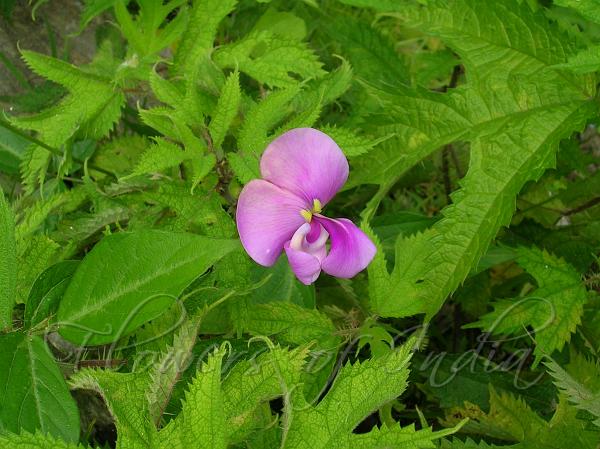
| Zombi Pea |

|
 |

|


| File size | 688594 |
| Original date | 8/17/06 12:39 PM |
| Resolution | 2048 x 1536 |
| Flash | Flash did not fire, auto |
| Focal length | 8.0mm |
| Exposure time | 1/185s |
| Aperture | 5.5 |
| Focus Distance | |
| Metering Mode | Partial |
| Camera make | NIKON |
| Camera model | E3700 |
| Sensor type |
 |
 ative ative |
 |
 |
Photo: |
Botanical name: Vigna vexillata Family: Fabaceae (pea family)
Zombi pea is a fairly strong twiner, stems usually clothed with spreading
silky hairs. It resembles a plant somewhere between a Southern pea and a
mung bean. The long trailing vines have narrow pointed bean-like leaves.
Pods and seeds resemble mung beans, and the roots are nodulated. Flowers
pink or purplish, turning yellow, pea-like, 2.5 cm long. Because of
its tuberous roots rather than its pods, the wild mung is held in fairly
high esteem in some parts of the world. In Africa, the roots are eaten
in times of severe hunger. It grows wild in the Himalayas and in the
foothills of India. The tubers are soft, easy to peel, and possess a
creamy, white, tasty interior. They are eaten boiled or raw. Protein
content of the tubers is near the 15% level, which is high compared to
the 1-7% for potatoes and yams.
Medicinal uses:  The whole plant is used in Ayurvedic medicine. Mudgaparni’s initial
action is important for the formation of the first tissue that sustains
the other tissues. It is effective for joint disorders, arthritis,
swellings in joints. As a hemostatic it checks hemorrhaging thus prolongs
life in individuals suffering from internal bleeding while building
their strength with its nutritive action.
The whole plant is used in Ayurvedic medicine. Mudgaparni’s initial
action is important for the formation of the first tissue that sustains
the other tissues. It is effective for joint disorders, arthritis,
swellings in joints. As a hemostatic it checks hemorrhaging thus prolongs
life in individuals suffering from internal bleeding while building
their strength with its nutritive action.
The whole plant is used in Ayurvedic medicine. Mudgaparni’s initial
action is important for the formation of the first tissue that sustains
the other tissues. It is effective for joint disorders, arthritis,
swellings in joints. As a hemostatic it checks hemorrhaging thus prolongs
life in individuals suffering from internal bleeding while building
their strength with its nutritive action.| Identification credit: Pravin Kawale | Photographed in Govindghat-Ghangria route, Uttarakhand & Rajouri, J&K. |
• Is this flower misidentified? If yes,