
| Broadleaf Plantain |

|
 |

|


| File size | 2218193 |
| Original date | 11/7/08 3:21 PM |
| Resolution | 2560 x 1920 |
| Flash | Flash did not fire, auto |
| Focal length | 16.2mm |
| Exposure time | 1/80s |
| Aperture | 3.6 |
| Focus Distance | |
| Metering Mode | Multi-segment |
| Camera make | Panasonic |
| Camera model | DMC-FZ18 |
| Sensor type | OneChipColorArea |
 |
 ative |
 |
 |
Photo: |
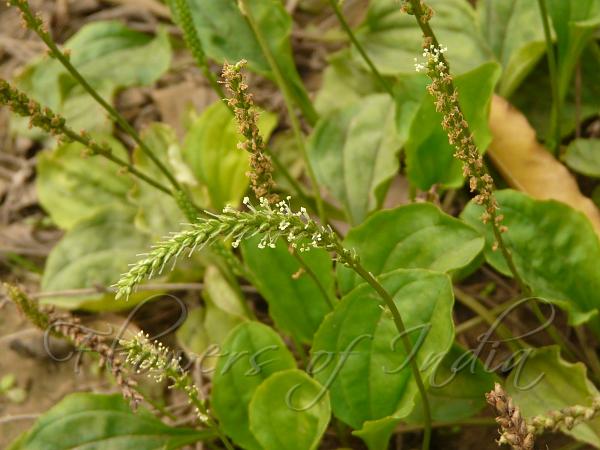
Botanical name: Plantago major Family: Plantaginaceae (Isabgol family)
Broadleaf plantain is a perennial herb, variable with short stout, erect,
truncate, rootstocks and numerous adventitious roots. Leaves appear in
rosettes, spirally arranged, stalked, sometimes not clearly distinguished
into stalk and the blade. Leaves are ovate-elliptic or rarely circular,
10-20 cm long, 4-9 cm broad, rounded at the tip, entire, nearly entire or
slightly toothed, 3-9 nerved, nerves divergent at the base. Leaf bases
taper into long sheathing stalks usually equalling the blade. Leafless
flowering stems are many, 13-15 cm long, arched, erect. Flower spikes are
dense or lax, slender, narrow-cylindric, 5-15 cm long. Bracts are equal to
or shorter than the sepal cup, ovate-oblong, acute, brownish with a brown
keel. Sepals are broadly elliptic, oblong to rounded obtuse. Flowers are
greenish or yellowish white, 2-4 mm long, petals elliptic-ovate to
narrowly triangular, 1-1.15 mm long, obtuse or acute, reflexed. Anthers
are at first lilac, later whitish or yellowish. Broadleaf plantain is
native to Temp. Eurasia to Arabian Peninsula, Macaronesia, N. & S. Africa
and the Himalayas. Flowering: August-October.
Medicinal uses: Plantain leaves were used commonly in folk medicine for skin poultices
on wounds, sores, or insect stings. The root was used for fever and
respiratory infections.
Medicinal uses:
Plantain leaves were used commonly in folk medicine for skin poultices
on wounds, sores, or insect stings. The root was used for fever and
respiratory infections.
| Identification credit: Tabish | Photographed in Talkatora Garden, Delhi & Srinagar, Kashmir. |
• Is this flower misidentified? If yes,