
| Indian Boodyarra |

|
 |

|


| File size | 648374 |
| Original date | 9/28/08 10:37 AM |
| Resolution | 2048 x 1536 |
| Flash | Flash did not fire, auto, red-eye reduction |
| Focal length | 5.8mm |
| Exposure time | 1/60s |
| Aperture | 2.6 |
| Focus Distance | |
| Metering Mode | Multi-segment |
| Camera make | Canon |
| Camera model | Canon PowerShot A530 |
| Sensor type | OneChipColorArea |
 |
 ative ative |
 |
 |
Photo: |
Botanical name: Aglaia roxburghiana Family: Meliaceae (Neem family)
Synonyms: Aglaia talbotii, Milnea roxburghiana
Synonyms: Aglaia talbotii, Milnea roxburghiana
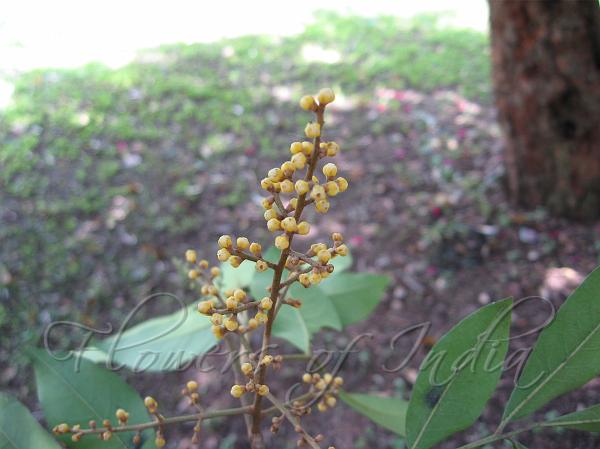
Indian Boodyarra is an evergreen tree found in the dense and moist forests in
Western Ghats, and also in many drier parts of India. It grows up to 10 m
tall, with greyish brown bark. Leaves are alternate to subopposite, 10-20
cm long, compound with 3-7 leaflets. Leaflets are opposite to subopposite,
elliptic, or oblong-elliptic, 6-12 cm long, 2.5-5.5 cm wide. Roundish
yellow flowers are borne in panicles, which are shorter than leaves, in
the leaf axils, covered with small scales. Sepals are 5, rounded, outside
rust-colored or yellowish scaly. Petals are 5, oblong, 1-1.5 mm, smooth or
yellowish scaly, tip rounded. Stamen tube is nearly spherical, slightly
shorter than petals, giving the flowers are ball-like appearance.
Fruit is obovoid when immature, ellipsoid or nearly spherical when ripe,
1-2.2 cm across; pericarp pale brown, orange or yellow, thin and brittle
when dry, densely covered on the outside with scales. Indian Boodyarra is
found in India and Sri Lanka Flowering: September-December.
| Identification credit: Sankara Rao, Varun Sharma | Photographed in Karnataka. |
• Is this flower misidentified? If yes,