
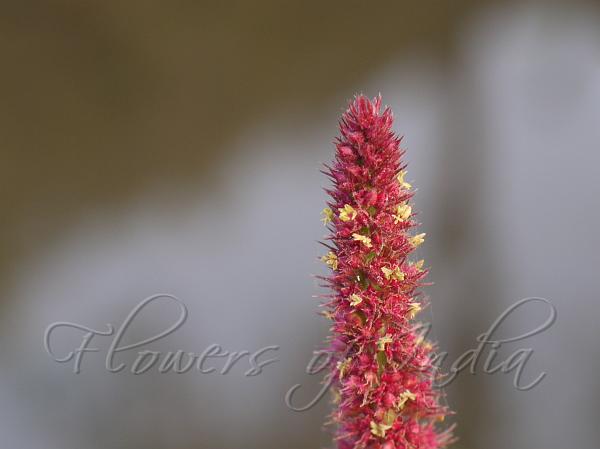
| Red Amaranth |

|
 |

|


| File size | 1451958 |
| Original date | 12/7/09 4:55 PM |
| Resolution | 2048 x 1536 |
| Flash | Flash did not fire, auto |
| Focal length | 45.0mm |
| Exposure time | 1/60s |
| Aperture | 5.6 |
| Focus Distance | |
| Metering Mode | Multi-segment |
| Camera make | Panasonic |
| Camera model | DMC-G1 |
| Sensor type | OneChipColorArea |
 |
 aturalized aturalized |
 |
 |
Photo: |
Botanical name: Amaranthus cruentus Family: Amaranthaceae (Amaranth family)
Synonyms: Amaranthus hybridus subsp. cruentus, Amaranthus anacardana, Amaranthus aureus
Synonyms: Amaranthus hybridus subsp. cruentus, Amaranthus anacardana, Amaranthus aureus
Red Amaranth is a tall annual herb topped with clusters of dark pink
flowers. The plant can grow up to 6 ft tall in height, and blooms in
summer to fall. Stems are erect, green or reddish purple, branched
distally, mostly in inflorescence, to nearly simple. Leaves are carried on
stalks half as long as, or equaling the blade. Blade is rhombic-ovate or
ovate to broadly lanceshaped, 3-15 × 1.5-10 cm, occasionally larger in
robust plants, margins entire. Inflorescences arise at the end of branches
and in leaf axils, erect, reflexed, or nodding, usually dark red, purple,
or deep beet-red, less commonly almost green or greenish red, leafless at
least distally , large and robust. This species was in use as a food
source in Central America as early as 4000 BC. The seeds are eaten as a
cereal grain. They are black in the wild plant, and white in the
domesticated form. They are ground into flour, popped like popcorn, cooked
into a porridge, and made into a confectionery called alegría. The leaves
can be cooked like spinach, and the seeds can be germinated into
nutritious sprouts. While A. cruentus is no longer a staple food,
it is still grown and sold as a health food. In Maharashtra, during month of
Shravan, a stir fried vegetable with just grated coconut is served during
festivals. The stem is used in curry made up of Vaal Hyacinth bean.
| Identification credit: Satish Pardeshi, Leo Breman | Photographed at Rajguru Nagar, Pune. |
• Is this flower misidentified? If yes,