
| Sweet Viburnum |

|
 |

|


| File size | 1131824 |
| Original date | 4/13/26 1:26 PM |
| Resolution | 240 x 320 |
| Flash | Flash did not fire, auto |
| Focal length | 6.72mm |
| Exposure time | 1/2004s |
| Aperture | 1.69 |
| Focus Distance | |
| Metering Mode | Center weighted average |
| Camera make | Xiaomi |
| Camera model | Mi 10 |
| Sensor type | MonochromeArea |
 |
 ative ative |
 |
 |
 |
Photo: |
Botanical name: Viburnum odoratissimum Family: Viburnaceae (Viburnum family)
Synonyms: Microtinus odoratissimus, Viburnum simonsii, Viburnum sinensis
Synonyms: Microtinus odoratissimus, Viburnum simonsii, Viburnum sinensis
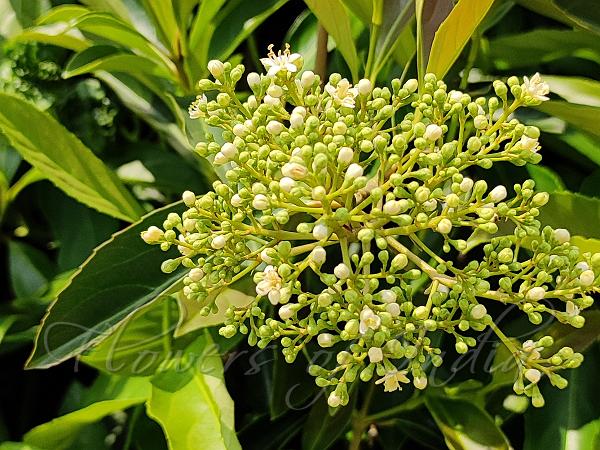
Sweet Viburnum is an evergreen shrub or small tree
reaching 10-15 m in height. Flowers appear after the leaves in
pyramidal panicles, 6-13.5 x 4.5-6 cm, borne at branch ends or short
lateral branchlets. The inflorescences lack large sterile radiant
flowers. Individual flowers are small, fragrant, white turning
yellowish or reddish with age, about 7 mm in diameter, with reflexed
lobes and yellow oblong anthers. The tree has gray-brown bark and green
or reddish young branchlets that are hairless or sparsely covered with
yellow-brown star-shaped hairs. Older branchlets become grayish with
scattered raised warts. Winter buds are ovoid-lanceshaped with 2-4
pairs of separate scales. Leaves are always opposite, leathery, glossy
dark green above, elliptic to obovate or nearly round, measuring 7-20 x
4-9 cm. The leaf margins are irregularly sawtoothed except near the
base, and the prominent pinnate veins form a distinct network. Leaf
stalks are robust, 1-2 cm long. Fruits are initially red, later
becoming blackish at maturity, ovoid to ellipsoid, about 8 x 5-6 mm,
containing compressed pyrenes with a deep ventral groove. Sweet
Viburnum is found in NE India to Central China and Central Malesia,
Taiwan. Flowering: March-May.
| Identification credit: Saroj Kasaju | Photographed in Thenzawl, Serchhip district, Mizoram. |
• Is this flower misidentified? If yes,