
| Worm Killer |

|
 |

|


| File size | 293026 |
| Original date | |
| Resolution | 1024 x 768 |
| Flash | Flash did not fire |
| Focal length | |
| Exposure time | 1/11s |
| Aperture | 0.0 |
| Focus Distance | |
| Metering Mode | Multi-segment |
| Camera make | Wolverine |
| Camera model | COACH |
| Sensor type | OneChipColorArea |
 |
 ative ative |
 |
 |
Photo: |
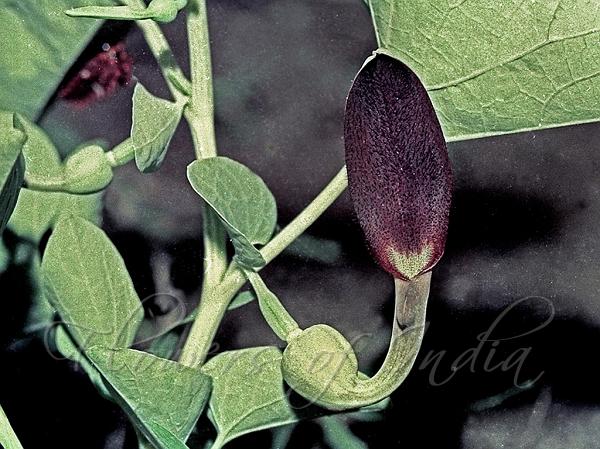
Botanical name: Aristolochia bracteolata Family: Aristolochiaceae (Birthwort family)
Synonyms: Aristolochia kotschyi, Aristolochia abyssinica
Synonyms: Aristolochia kotschyi, Aristolochia abyssinica
A perennial prostrate, herb, with an unpleasant smell.
Stem are striped, hairless. Leaves are hairless, 1.5-3 cm long, blade
ovate, blunt, arrow shaped at the base, margin wavy, 3-7 x 3-7 cm,
hairless above, glaucous beneath, leaf-stalk striped. Flowers are
2.5-4 cm long, irregular, tubular with a linear lip, hairless externally,
hairy inside, dark purple on the side of the lip, greenish yellow on
the other side and in the tubular portion. Stamens are 6, stalkless,
anthers united with a 6-lobed gynostegium. Flowers have bracts
which are large, round, 1-1.3 cm long, hairless. Flower-stalks are
5-10 mm long. Capsules are 2-3 cm long, 12-ribbed, hairless.
Seeds are many, 5-7 mm long, flat and dark coloured.
Medicinal uses: The paste of the leaf of
Kitamari is applied over the wounds for helping in quick healing. The
decoction of the leaf is consumed in a dose of 50 ml to treat
dysmenorrhea and difficulty in labor. The decoction of the bark or
whole plant is taken in a dose of about 40 ml to treat intestinal worm.
The paste of the leaf of Kitamari is applied over eczema for its
treatment. The powder of the seed is given with powder of black pepper
to treat fever. The paste of the root is applied over the area over
localized swelling for its treatment.
The paste of the leaf of
Kitamari is applied over the wounds for helping in quick healing. The
decoction of the leaf is consumed in a dose of 50 ml to treat
dysmenorrhea and difficulty in labor. The decoction of the bark or
whole plant is taken in a dose of about 40 ml to treat intestinal worm.
The paste of the leaf of Kitamari is applied over eczema for its
treatment. The powder of the seed is given with powder of black pepper
to treat fever. The paste of the root is applied over the area over
localized swelling for its treatment.
Medicinal uses:
The paste of the leaf of
Kitamari is applied over the wounds for helping in quick healing. The
decoction of the leaf is consumed in a dose of 50 ml to treat
dysmenorrhea and difficulty in labor. The decoction of the bark or
whole plant is taken in a dose of about 40 ml to treat intestinal worm.
The paste of the leaf of Kitamari is applied over eczema for its
treatment. The powder of the seed is given with powder of black pepper
to treat fever. The paste of the root is applied over the area over
localized swelling for its treatment. | Identification credit: P.S. Sivaprasad | Photographed in Nilambur, Coimbatore distt., Tamil Nadu. |
• Is this flower misidentified? If yes,